
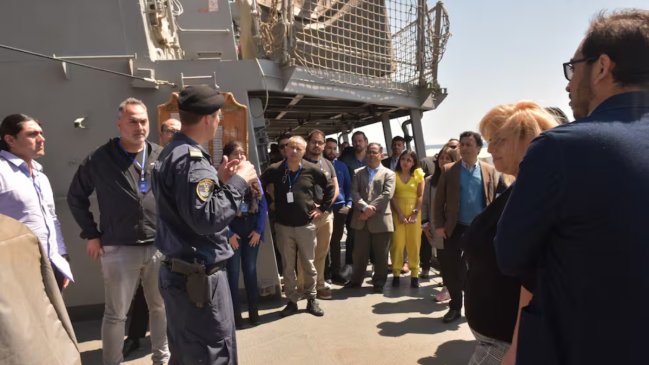
On April 10, as part of the International Air and Space Fair (FIDAE), the fourth edition of the Dual Hub Summit took place, an event that marks a milestone for “dual innovation” in Chile and Latin America. Taky Parvex, senior manager at Know Hub Chile, explained this concept, which refers to technological collaboration between the defense sector and civil society.
In addition, the event served to open up opportunities for networking, visibility, and technology transfer within this ecosystem. For example, one of the talks addressed the topic “Defense and Intelligence in Complex Environments: Sovereignty, Resilience, and Rapid Decision-Making.” “‘Dual innovation’ was created to define spaces for collaboration in development processes and seek mutual benefits,” the expert told La Nueva Industria.
The goal of Know Hub Chile, which began operations in 2019, is to turn science into innovation. Along the way, they have identified a number of gaps that they aim to address through their programs. “We had to find a way to replicate these experiences, and the Chilean Navy was part of our first programs,” said Parvex.
“There is a definition—and an analysis—that evolves as the dynamics and capabilities of research and development change, particularly in the civilian sector, which is outpacing those capabilities. Meanwhile, in the broader application of the concept, it no longer covers just defense, but also other mission-oriented institutions. Furthermore, major challenges must be addressed, such as climate change, security, ecosystem protection, etc.,” Taky Parvex, senior manager at Know Hub Chile.
When asked whether Chile could become a strategic hub for “dual innovation,” the expert emphasized that this is not only an opportunity for the country to establish itself in this field, but also a necessity to embrace these areas and accelerate progress. “One of our goals is to strengthen the role of Know Hub and promote innovation and entrepreneurship in technology transfer,” he said.
Other ecosystems
Taky Parvex explained that “dual innovation” is a phenomenon that has been observed for many years, but that, over the past two decades, the private sector’s pace and capabilities in research and development have far surpassed those of any government. “It all started in the United States, because they realized that the military was falling behind in technology. For that reason, the defense sector had to start incorporating civilian technologies into its operations,” he explained.
The senior manager at Know Hub Chile explained that his company’s first projects were with the Chilean Navy (2019–2020), focusing on surveillance of activities at sea. “Illegal fishing, drug trafficking, and the trafficking of various substances fall under the Navy’s purview. And one of those solutions is Marine Acoustics, where we developed a system of buoys equipped with AI that can identify vessels through sound,” he explained.
Finally, another application of the system relates to the conservation of marine wildlife. “So today, this same system is being implemented throughout Chile to detect, for example, the passage of cetaceans and determine when a port can or cannot operate. Or to assess the potential impact of ocean-based operations that could affect such wildlife,” said Parvex.
Check out the interview here: