
GPS, microwave ovens, and EpiPens have something in common: they originated in the defense sector before becoming everyday technologies. This phenomenon, known as dual innovation, is the focus of Know Hub Chile and its Dual Hub platform, the first permanent initiative of its kind in Latin America.
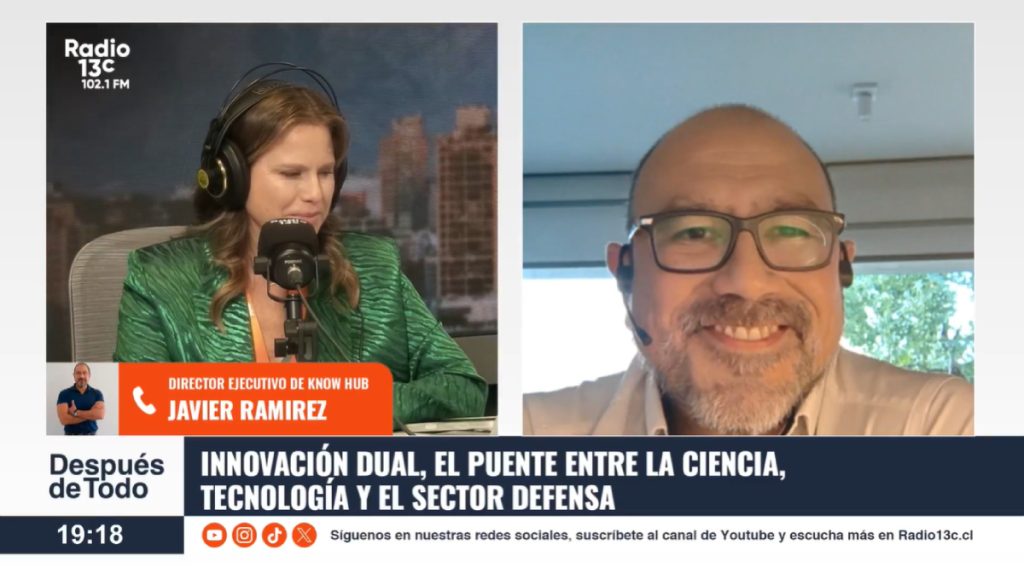
To discuss this, Radio 13C’s program “Después de Todo” invited Javier Ramírez, executive director of Know Hub Chile, who spoke with host Soledad Onetto about the model, its results, and Chile’s place within this regional ecosystem.
What is Know Hub Chile, and where did it come from?
Know Hub Chile is a nonprofit organization established in 2018 as part of a government policy to transform scientific research findings generated at universities and research centers into products and services that have an impact on the market. It originally emerged as a Corfo initiative and now operates as a technology transfer hub under ANID.
Its core mission has been precisely to bridge a long-standing gap: the divide between science and its real-world applications. “That has been the assessment of public policy from the very beginning,” Ramírez noted during the interview, emphasizing that the government has played a role not only in providing funding but also in offering strategic guidance to the ecosystem.
Chile as a regional leader
When comparing the country’s progress with other international models, Ramírez was blunt: “We’re leading the way in Latin America.” This statement acknowledges that Chile has established an effective partnership between the government, industry, and academia which, specifically in the area of dual innovation, places the country in a favorable position even compared to some European nations.
What is dual innovation, and why does it matter?
Dual-use innovation refers to the process by which technologies developed for the defense sector find applications in civilian life, or when solutions originating outside the military sphere are adapted for use by the armed forces. Cell phones, the internet, GPS, microwave ovens, and mosquito repellents all have their origins in defense sector research or needs, as Ramírez noted in the interview.
One of the most striking examples he mentioned is the EpiPen, the epinephrine injection device used today by people with severe allergies. Its design originated during the Iran-Iraq War, when the U.S. military needed a rapidly administered antidote for chemical weapons attacks that could be used with minimal training and under conditions of panic. Decades later, that same principle made its way into pharmacies as an emergency tool for civilian use.
An important distinction made by Ramírez was the one between military technology and defense technology. The former is combat-oriented; the latter addresses the operational, logistical, and human challenges faced by defense institutions—challenges that are often shared with the rest of society. “The armed forces should be viewed as a miniature version of Chile,” he noted, where the same challenges related to health, infrastructure, and development exist as those faced by the country as a whole.
The Avante Challenge and Strategic Shipbuilding
One of the flagship programs of this initiative is the Avante Challenge, developed in partnership with the Chilean Navy. In its fourth edition, it received 32 applications, selected 10 teams for a 15-week collaborative process, and narrowed the field down to three finalists.
The program was created to connect the Navy with the science and technology ecosystem, as part of the National Shipbuilding Plan, which aims to have 100% of the Chilean fleet built domestically starting in 2030. The need was not only technical but also cultural: the Navy did not know how to engage with startups, and startups were unaware that defense institutions could be significant clients. The Avante Challenge served as the bridge.
Dual Hub Summit at FIDAE
The fourth edition of the Dual Hub Summit took place on April 10, 2025, as part of FIDAE, Latin America’s leading aerospace and defense trade show. The event brought together representatives from academia, startups, investment funds, industry, the public sector, and the armed forces for a shared dialogue.
According to Ramírez, the Summit came about after it was realized that the main obstacle to effective collaboration was not technical, but cultural: each sector speaks a different language, operates under different incentives, and has different ways of understanding problems. The Summit aims to gradually bridge these cultural divides to make genuine collaboration possible.
Check out the full interview here: