
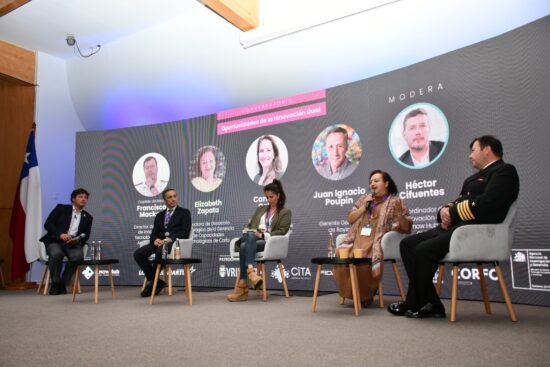
Dual innovation, a bridge between science and defense, is gaining momentum as a key strategy for national development. This is demonstrated by the Dual Hub Summit, which, in its second edition, “Dual Hub: An Opportunity for the Country”, to beheld on August 5 at the Faculty of Physical and Mathematical Sciences of the University of Chile, will bring together leaders from the public sector, defense, academia, industry, and entrepreneurship with a common goal: to coordinate capabilities and boost the country’s growth through shared technological solutions.
Organized byKnow Hub Chile, this event aims to highlight real-world examples, open up new opportunities for collaboration, and build an active community around dual-use innovation, which, as Javier Ramírez, executive director of Know Hub Chile, explains, “connects scientific knowledge with the country’s specific needs, enabling defense-related development to be transformed into solutions that also benefit civil society.”
For countries like Chile and those in Latin America, dual-use innovation has become a concrete tool for bridging the historical gap between the defense sector and the science, technology, knowledge, and innovation (STKI) ecosystem. International examples confirm this: the Roomba robotic vacuum cleaner, created by iRobot, is a dual innovation because its technology and knowledge originated in the defense sector and were successfully adapted to the civilian market; drones, designed for reconnaissance, now support agriculture and logistics; and oxygenation technology, key in submarines, has found applications in mining and hospitals.
It is no longer an emerging field, but an established reality. For example, initiatives by the U.S. Department of Defense, such as the Defense Innovation Unit (DIU), increased theirbudget for 2024to $983 million, up from $70 million in 2023. And in Europe, while global venture capital investment contracted by about 25–26% in 2024, according to KPMG Private Enterprise’s Venture Pulse report, reaching its lowest level in nearly seven years and reflecting a decline in transaction volume and value; venture capital investment in defense technologies and dual-use applications quadrupled since 2018, reaching $3.9 billion in 2024, according to thelatest reportfrom Dealroom, a global provider of data and intelligence on startups and technology ecosystems.
From the lab to real-world impact
In Chile, this strategy opens up opportunities for universities, startups, and industries to collaborate with the defense sector while generating social and economic impact. “Dual-use innovation is neither a distant concept nor one exclusive to the military. It is a real opportunity to diversify the economic structure, promote technological autonomy, and create high-value jobs,” Ramírez notes.
Know Hub Chile, through its Dual Hub platform, has established itself as a catalyst for initiatives that promote public-private collaboration. One example is the Avante Challenge, developed in partnership with the Navy’s Center for Technological Innovation, which invites startups and research teams to solve naval challenges with potential for civilian applications.
Another flagship initiative is Proa I+D, a program that connects researchers with the Navy to accelerate technology transfer processes through the joint development of solutions of institutional interest. Among its achievements, the oxygenation project led by Dr. Flavia Zacconi stands out; it has now been awarded Fondef funding to continue its development. In this initiative, the Chilean Navy participates as a partner, actively contributing to the design and validation of the solution and facilitating access to facilities, knowledge, and key capabilities for its implementation.
In addition, initiatives such as the Fortis Challenge—a collaboration with the international company Lockheed Martin that was awarded to Austral University—allow for the exploration of new applications for the FORTIS exoskeleton, demonstrating the potential of dual-use technology in areas such as mining and wildfire suppression.
To further this vision, Know Hub Chile has also launched theDual Innovation Book,a publication produced in collaboration with the Navy’s Center for Technological Innovation, which compiles expert insights, interviews, and national and international case studies. The aim is to bring the topic into the public discourse and provide a roadmap for those leading innovation processes in universities, research centers, the armed forces, and industry.
Deepening the dialogue
The first Dual Hub Summit, held in May 2025 in Concepción, drew more than 230 attendees, featured seven thematic sessions, and showcased several examples of effective collaboration. The event made it clear that dual innovation is not an abstract concept, but a concrete and achievable tool for Chile. It also highlighted the urgent need to address the structural disconnect between strategic sectors and the national science and technology ecosystem.
The second meeting, to be held in Santiago, aims to build on this progress by promoting a strategy that links existing capabilities with real-world challenges. “We want scientific knowledge to be put into practice and for public investment in technology to serve as a catalyst for productive, regional, and sustainable development,” says Ramírez.
The executive director of Know Hub Chile notes that the task is not easy, but the potential is enormous. “With strategic vision and collective commitment, dual innovation can become a true engine of development for Chile.”

Among the featured speakers will beGene Keselman, executive director of Mission Innovation Experimental (MIx), a partner at Proto Ventures, and a faculty member at MIT’s Sloan School of Management, with extensive experience in the startup world and in the development of dual-use technologies.
Another notable speaker is Enrique Bustos Martín, who holds a Ph.D. in Chemistry and serves as the representative of the Center for Technological Development and Innovation (CDTI) in Chile. The CDTI, which reports to Spain’s Ministry of Science, Innovation, and Universities, has been a key player in promoting technological innovation in business, supporting Spanish companies and startups with more than 2.3 billion euros in 2024—a figure it plans to maintain in 2025 and beyond.
The event is sponsored by Lockheed Martin, Saab, and Oracle; supported by CORFO Bío-Bío, CORFO, and ANID; and backed by the Chilean Navy’s Center for Technological Innovation, the Chilean Air Force, FIDAE, Open Beauchef, the Faculty of Physical and Mathematical Sciences at the University of Chile, DTS, and the CDTI.